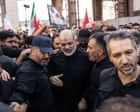
Iran seeks to tighten control over strait of Hormuz alongside Khamenei funeral
The News
During the funeral of Supreme Leader Ali Khamenei, Iran moved to tighten control over the Strait of Hormuz. The IRGC issued warnings that turned back ships and used Quranic passages to communicate with Gulf delegations. Analysts suggest that Khamenei's legacy is tied to Iran's dominance over the waterway, which is crucial for the global economy.
Infographic
No infographic was generated for this story. GreyNews is not leaving this spinning indefinitely.
The Analysis
Intelligence Brief
Analyzed · High confidence (80%)
Same as the summary above — this brief adds the distinct fields below.
Diplomatic and military contest for control
Some claim that Khamenei's legacy ultimately depends on Iran's grip on the Strait of Hormuz and thus the global economy.
4 claims still need verification.
No forecast extracted yet.
Key findings
Some claim that Khamenei's legacy ultimately depends on Iran's grip on the Strait of Hormuz and thus the global economy.
Opinion- Diplomatic and military contest for control
- Messages sent to Gulf delegations
Trust Breakdown
Plain English
Loaded language removedIRGC warnings force ships to turn back as Tehran uses passages from Qur’an to send messages to Gulf delegations. The diplomatic and military contest for control of the strait of Hormuz has intensified alongside the scenes of mourning for the death of Iran’s supreme…
Emotionally neutral rewrite. Same facts, calmer framing.
What's next
This angle has contested claims
Claims
Some claim that Khamenei's legacy ultimately depends on Iran's grip on the Strait of Hormuz and thus the global economy.
OpinionThe Islamic Revolutionary Guard Corps (IRGC) has issued warnings that forced ships to turn back from the Strait of Hormuz.
The GuardianIranian authorities used passages from the Qur’an to send messages to Gulf delegations regarding the Strait of Hormuz.
The GuardianOver the past 48 hours, the IRGC started to plug a gap in their monopoly control of the Strait of Hormuz.
The Guardian