
China plans to hit an asteroid with a Mach 26 projectile in planet defence test
The News
China is planning a planetary defence test before 2030 that involves slamming a spacecraft into an asteroid at high speed. This mission, outlined in a paper by Li Mingtao's team, is described as more ambitious than NASA's DART mission, aiming to directly alter the asteroid's orbit relative to Earth or break it apart. The test would advance planetary defense capabilities beyond previous proof-of-concept missions.
Infographic
The Analysis
Intelligence Brief
Analyzed
Same as the summary above — this brief adds the distinct fields below.
Direct comparison to NASA's DART mission
DART was a proof-of-concept that nudged one asteroid's orbit around another.
4 claims still need verification.
No forecast extracted yet.
4 unresolved.
Key findings
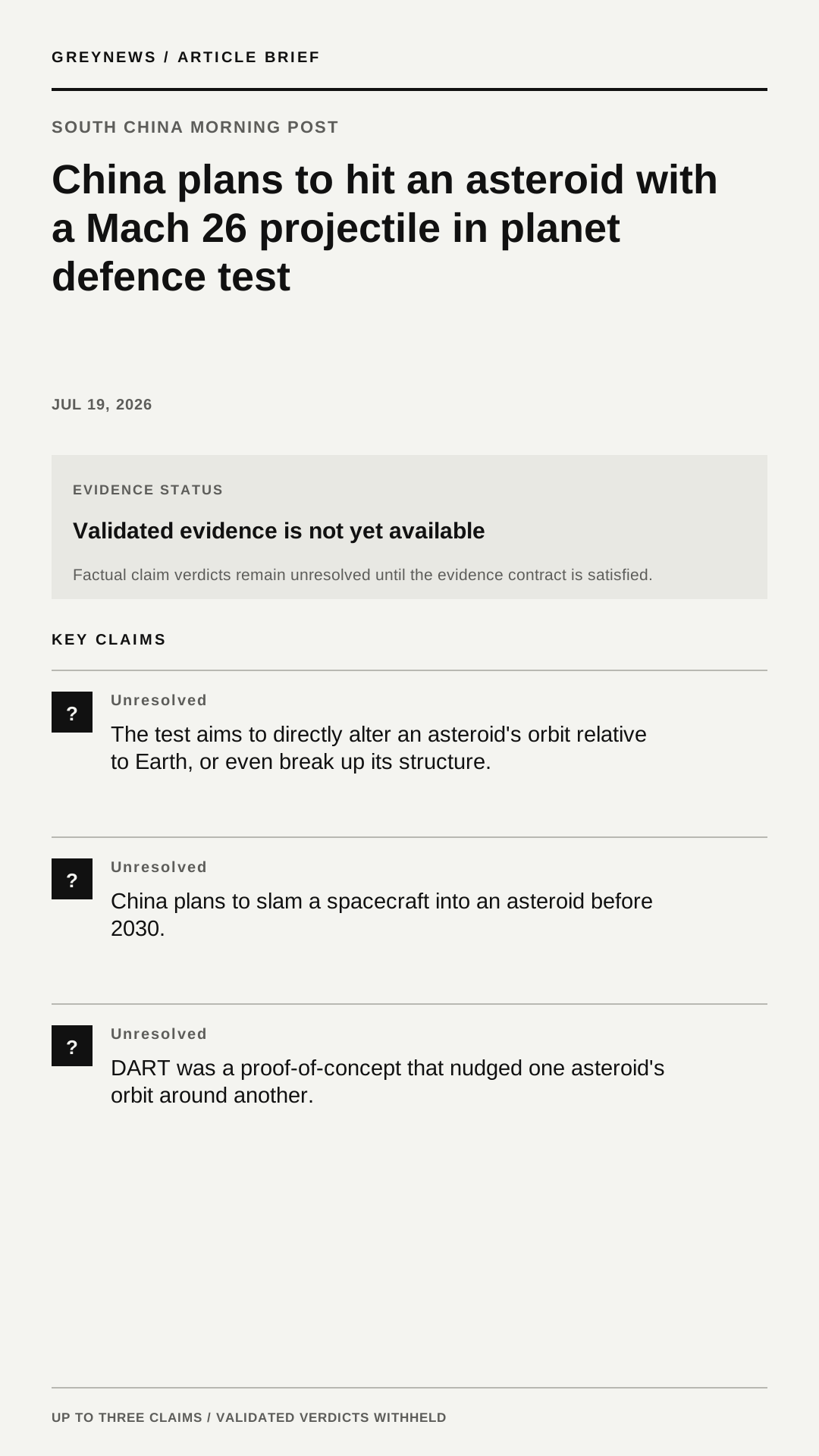
The test aims to directly alter an asteroid's orbit relative to Earth, or even break up its structure.
South China Morning Post- Direct comparison to NASA's DART mission
- Space as a domain for soft power and military dual-use
Plain English
Loaded language removedChina’s first planetary defence mission appears to be far more ambitious than Nasa’s Double Asteroid Redirection Test (Dart), according to a new paper outlining its plan to slam a spacecraft into an asteroid before 2030. Unlike Dart, a proof-of-concept that nudged one asteroid’s orbit around another, China is aiming for a more realistic planetary-defence test.
Emotionally neutral rewrite. Same facts, calmer framing.
What's next
This angle has contested claims
Claims
The test aims to directly alter an asteroid's orbit relative to Earth, or even break up its structure.
South China Morning PostChina plans to slam a spacecraft into an asteroid before 2030.
South China Morning PostDART was a proof-of-concept that nudged one asteroid's orbit around another.
South China Morning PostChina's first planetary defence mission is more ambitious than NASA's DART mission.
Opinion