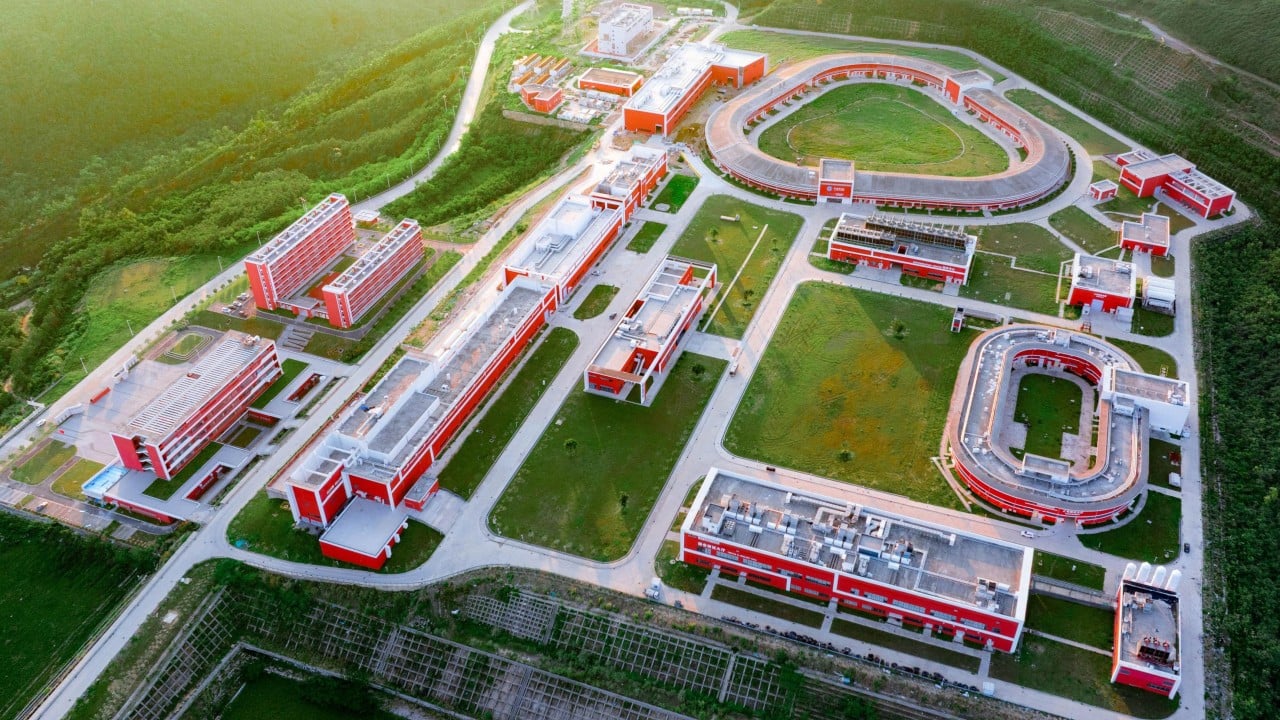
China fires up powerful particle accelerator to unlock secrets of atoms
The News
China has activated a new record-breaking particle accelerator in Huizhou, Guangdong, which produces the world's most intense beams of charged atoms. The 2.6 billion yuan facility will enable scientists to create previously unknown atomic nuclei and advance research in cancer treatment and spacecraft materials. Operations began after construction completed, as reported by state news agency Xinhua. This development underscores China's growing investment in high-energy physics and its applications.
Infographic
The Analysis
Intelligence Brief
Analyzed
China has activated a new record-breaking particle accelerator in Huizhou, Guangdong, which produces the world's most intense beams of charged atoms. The 2.6 billion yuan facility will enable scientists to create previously unknown atomic nuclei and advance research in cancer treatment and spacecraft materials. Operations began after construction completed, as reported by state news agency Xinhua. This development underscores China's growing investment in high-energy physics and its application...
China is now home to the world's most intense ion beams, challenging existing research hubs.
Scientific operations have begun at the 2.6 billion yuan (US$384.1 million) facility in Huizhou, Guangdong province after construction was completed on Tuesday.
3 claims still need verification.
No forecast extracted yet.
3 unresolved.
Key findings
China has brought online a record-breaking particle accelerator that can produce the world's most intense beams of charged atoms.
South China Morning Post- Investment of 2.6 billion yuan ($384.1 million) reflects significant government spending.
- Expected to drive innovation in medical treatments and aerospace materials, boosting related industries.
Plain English
Loaded language removedChina has brought online a record-breaking particle accelerator that can produce the world’s most intense beams of charged atoms. It gives scientists a new tool to create previously unknown atomic nuclei and advance research on cancer treatment and spacecraft materials.
Emotionally neutral rewrite. Same facts, calmer framing.
What's next
This angle has contested claims
Claims
China has brought online a record-breaking particle accelerator that can produce the world's most intense beams of charged atoms.
South China Morning PostThe accelerator gives scientists a new tool to create previously unknown atomic nuclei and advance research on cancer treatment and spacecraft materials.
South China Morning PostScientific operations have begun at the 2.6 billion yuan (US$384.1 million) facility in Huizhou, Guangdong province after construction was completed on Tuesday.
South China Morning Post